


Base Duo
Base Duo
Couldn't load pickup availability
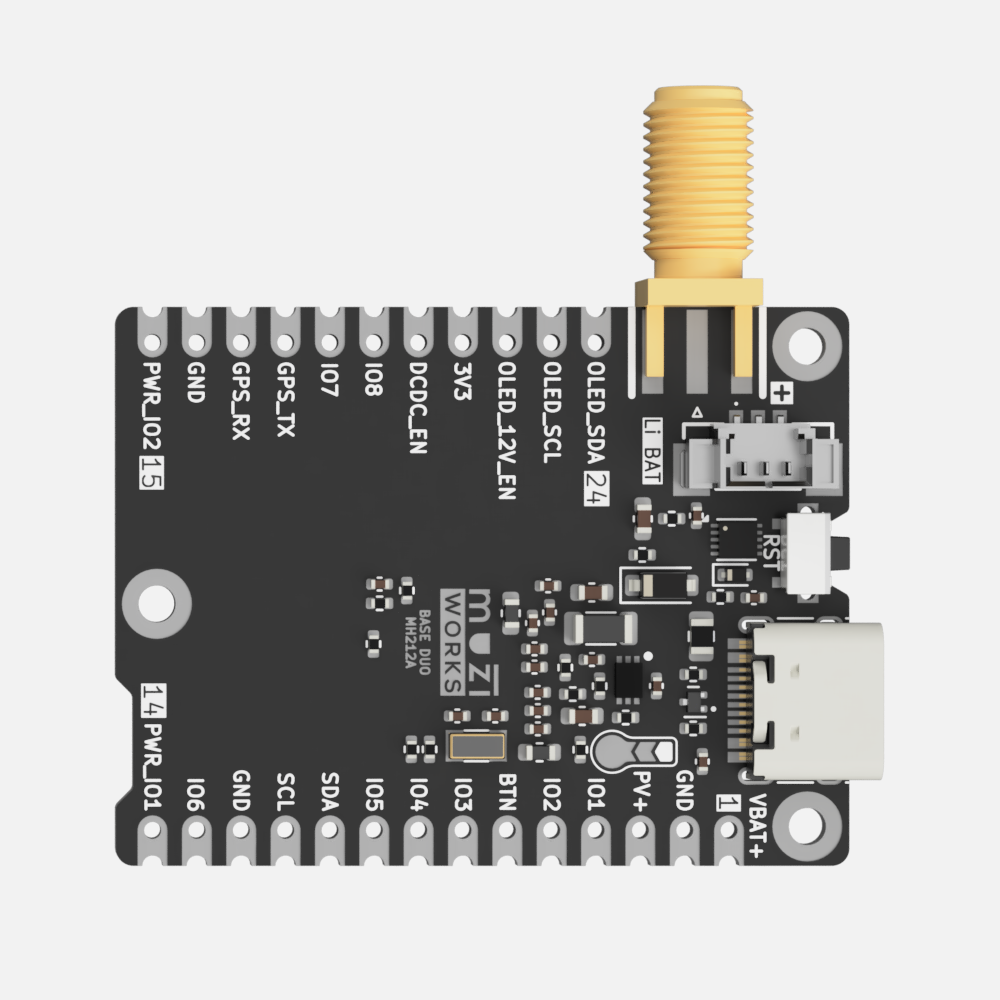
The heart of your Meshtastic® radio, engineered for performance and reliability. Featuring IO designed for ultimate flexibility. Dual Band LoRa.
Main Features
- Microcontroller: nRF52840
- LoRa Radio: LR1121
- 8MB QSPI Flash
- Buttons: User + Reset
- QWIIC / STEMMA QT Port
- Flexible IO: 8 GPIO + 2 Power IO + UART + I2C
- Meshtastic® Flashed and Licensed
Power System
- Compatible Battery Chemistry:
- Li-ion
- LFP (LiFePO4)
- Solar Power Input with VDPM
- USB-C Power:
- 500mA Default Charge
- 1A Fast Charge option
- Powerpath: Prevents battery discharge when power source is available
- Safety Protections:
- Input Overvoltage Protection
- Battery Undervoltage Protection
- Battery Short Protection
- Battery Overcurrent Protection
- Input Current Limit Protection
- Thermal Regulation and Thermal Shutdown
- Battery Thermal Fault Protection
- Advanced Charger IC: BQ28185
Product Includes
- Base Duo Board
- Sub-GHz LoRa Stubby Antenna
- 2.4GHz LoRa FPC Antenna
- Mounting Screws + Hex Key
- USB-C Cable
Specs
- Sub-GHz LoRa Connector: SMA
- 2.4GHz LoRa Connector: U.FL
- LoRa TX Max Power: 20dBm SubG / 11.5dBm 2.4G
- Bluetooth LE Antenna
- Bluetooth TX Max Power: 6dBm
- USB-C: Power and Data
- Battery Connector: 3-pin Molex PicoBlade
- Mounting Holes: 3x M2
- Board Size: 42x32mm
- Weight: 10g
In our resources section for the BASE System we provide an evolving user guide, documentation and downloads including spec sheets, schematics, software source files and more.
Share



remplis toute les attente
Little bit of solder and you're up and running...nice little device.
I love this board to death, it has so many nice features including solar input and external input connectors.
The battery life of this Nordic Chipset has a much better battery life than an ESP32 series.
My only complaint is my limited BT range. It could be my battery blocking some of it but the little ceramic built in BT antenna only feels like it has 3 feet of range.
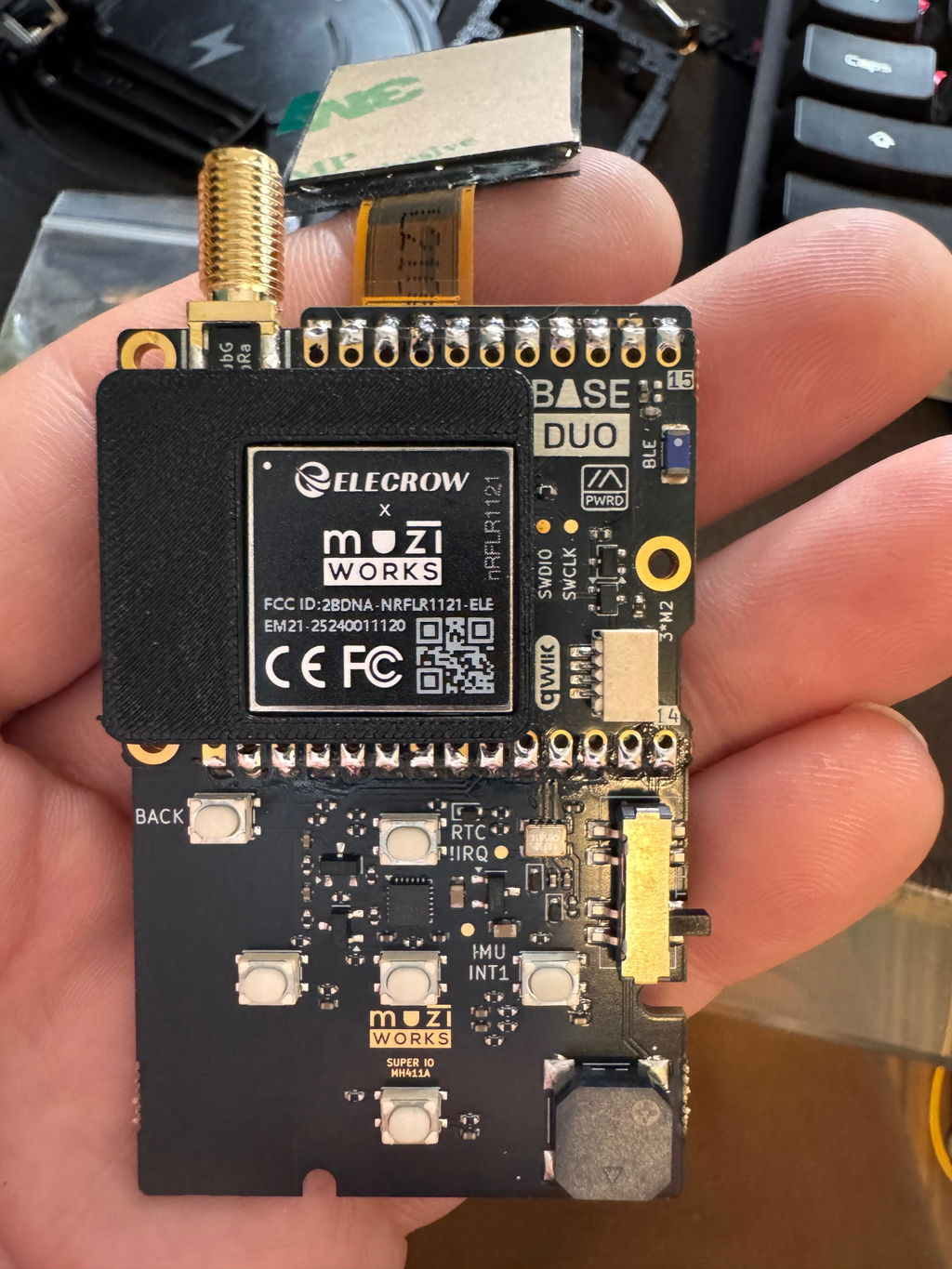
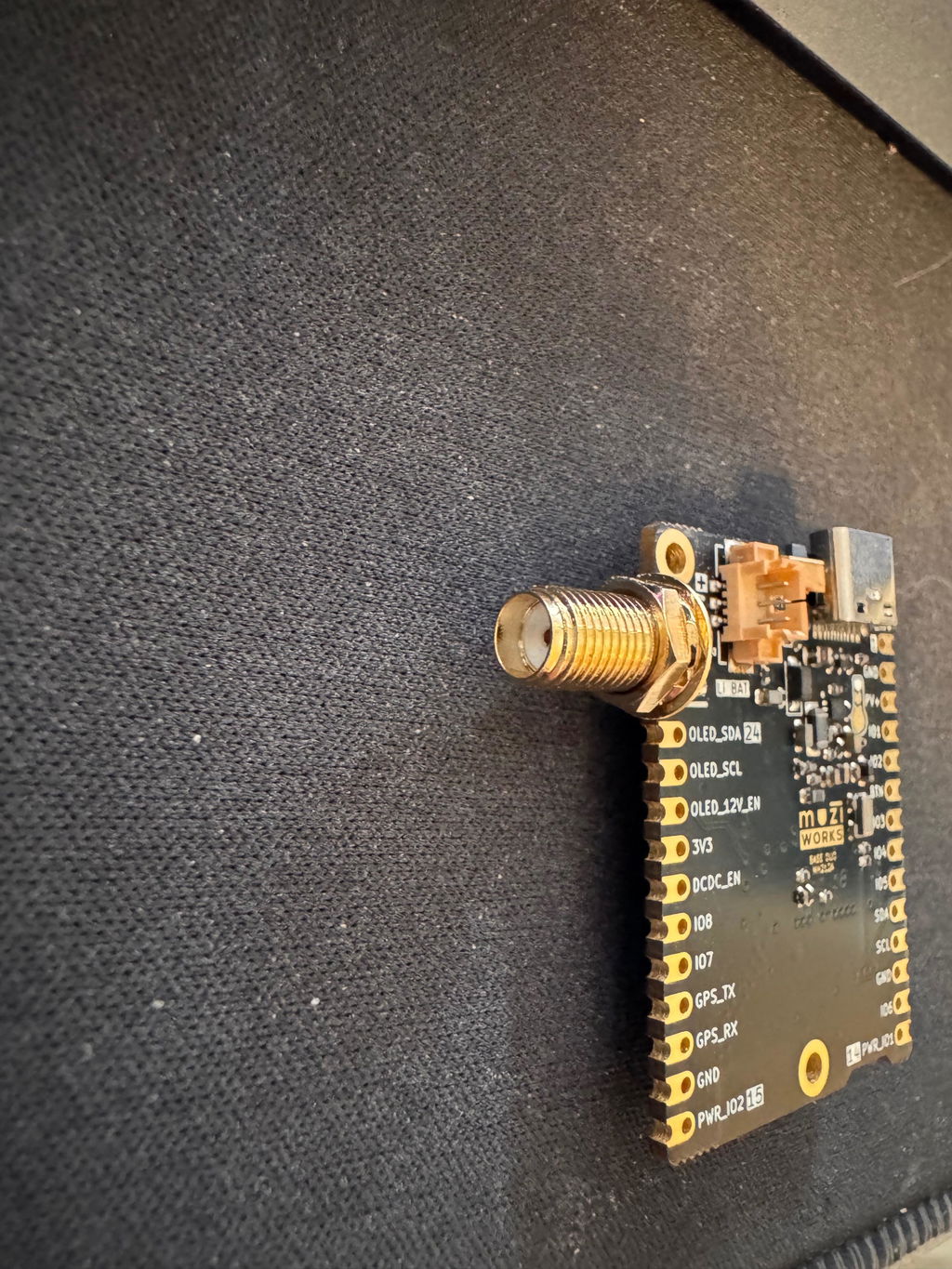
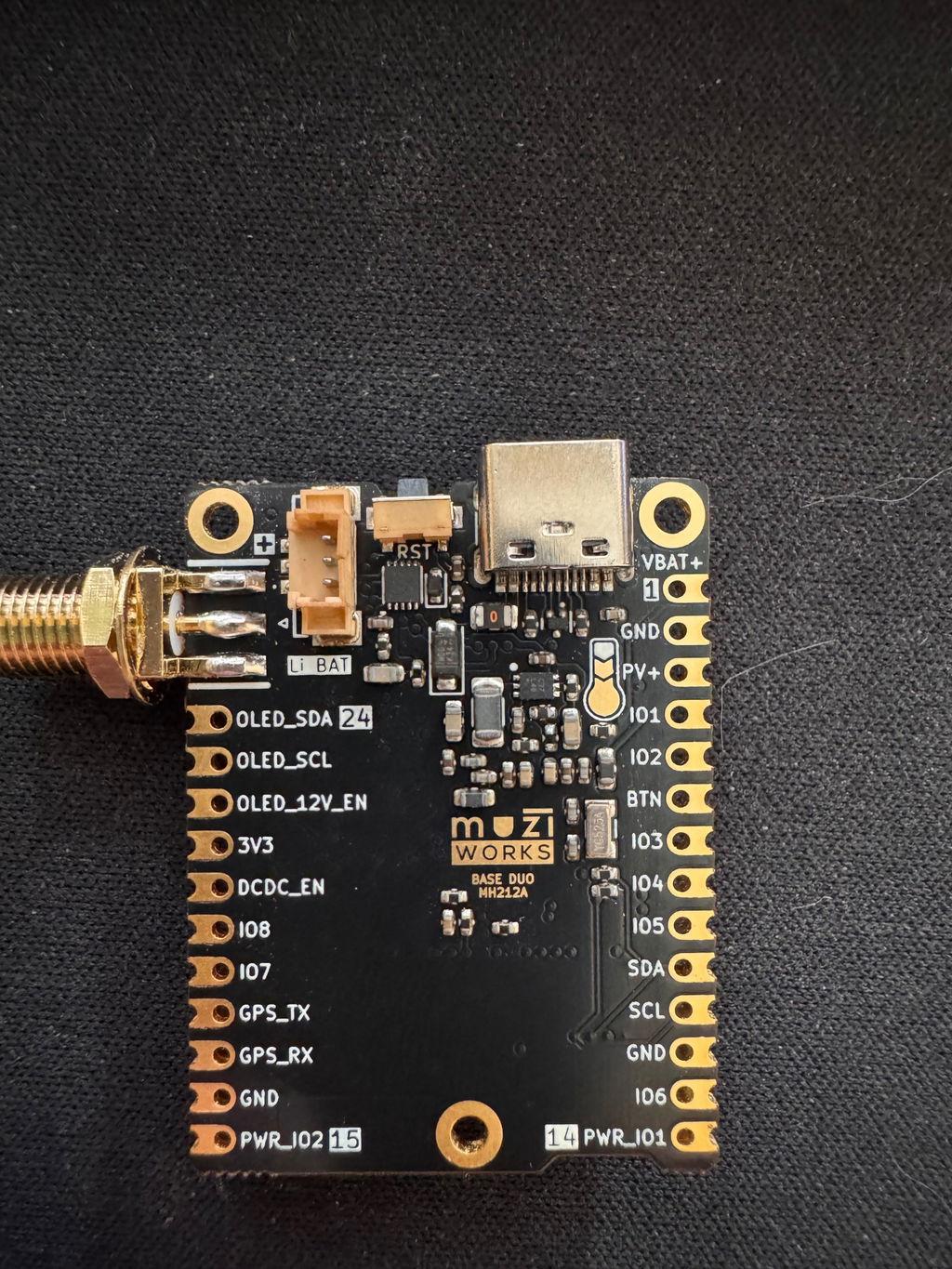
- Dual-band LR1121 chip: 915 MHz or 2.4 GHz LoRa on one radio, for $35
- muzi.works claims up to 12× faster throughput than Short Turbo at short range on 2.4 GHz
- Assembled in Atlanta from Nordic + Semtech silicon no PRC assembly, no PRC silicon
- Smaller than the RAK4631 stack, LiFePO4 compatible out of the box
If you're running a RAK4631 or any SX1262-based node, the BASE Duo is the most straightforward upgrade path in the Meshtastic ecosystem right now. Same nRF52840 MCU, Meshtastic-approved via the Backer Program, but built around Semtech's LR1121 instead of the SX1262.
The LR1121 puts both 915 MHz and 2.4 GHz LoRa on a single chip. No second radio needed. The LilyGO T-Lora Pager runs the same chip but costs nearly twice as much. Long range works exactly as you'd expect: 2 to 15 km at 915 MHz, same CSS modulation, same -141 dBm sensitivity as your existing nodes. When devices are close together, 2.4 GHz opens up 50–100 kbps at 200–400 meters, up to 12× faster than Short Turbo preset. For bulk transfers between nearby nodes, that matters.
The hardware is well-designed. The BQ28185 charger handles Li-ion and LiFePO4 interchangeably, adds solar input, USB-C fast charge, and proper fuel gauging — none of which the RAK19007 offers. At 42×32 mm it's smaller than the RAK4631 stack, schematics and STEP files are published, and muzi.works maintains their own upstream Meshtastic board support. Not a community fork. The LR1121 on nRF52840 is running in production firmware today.
On supply chain: assembled in Atlanta, Nordic nRF52840, Semtech LR1121 — no PRC assembly, no PRC silicon. The RAK4631 is assembled in Shenzhen. With the regulatory environment tightening around PRC-manufactured network hardware in 2026, the BASE Duo is the cleaner choice if provenance matters to your deployment.
Hardware seems decent, but no MeshCore support. As of March 2026 there's no official support.